Profile Stores Client services Implication Sponsors Employment
Shopping Cart (empty) Continue with order
  • You are here :
  • Home
  • >
  • Tips zone

Tips zone

Tennis

Game level

1.5
You have limited experience and are working primarily on getting the ball in play.

2.0
You lack court experience and your strokes need developing. You are familiar with the basic positions for singles and doubles play.

2.5
You are learning to judge where the ball is going, although your court coverage is limited. You can sustain a short rally of slow pace with other players of the same ability.

3.0
You are fairly consistent when hitting medium-paced shots, but are not comfortable with all strokes and lack execution when trying for directional control, depth, or power. Your most common doubles formation is one-up, one-back.

3.5
You have achieved improved stroke dependability with directional control on moderate shots, but need to develop depth and variety. You exhibit more aggressive net play, have improved court coverage and are developing teamwork in doubles.

4.0
You have dependable strokes, including directional control and depth on both forehand and backhand sides on moderate-paced shots. You can use lobs, overheads, approach shots and volleys with some success and occasionally force errors when serving. Rallies may be lost due to impatience. Teamwork in doubles is evident.

4.5
You have developed your use of power and spin and can handle pace. You have sound footwork, can control depth of shots, and attempt to vary game plan according to your opponents. You can hit first serves with power and accuracy and place the second serve. You tend to overhit on difficult shots. Aggressive net play is common in doubles.

5.0
You have good shot anticipation and frequently have an outstanding shot or attribute around which a game may be structured. You can regularly hit winners or force errors off of short balls and can put away volleys. You can successfully execute lobs, drop shots, half volleys, overhead smashes, and have good depth and spin on most second serves.

5.5
You have mastered power and/or consistency as a major weapon. You can vary strategies and styles of play in a competitive situation and hit dependable shots in a stress situation.

6.0 to 7.0
You have had intensive training for national tournament competition at the junior and collegiate levels and have obtained a sectional and/or national ranking.

Grip size

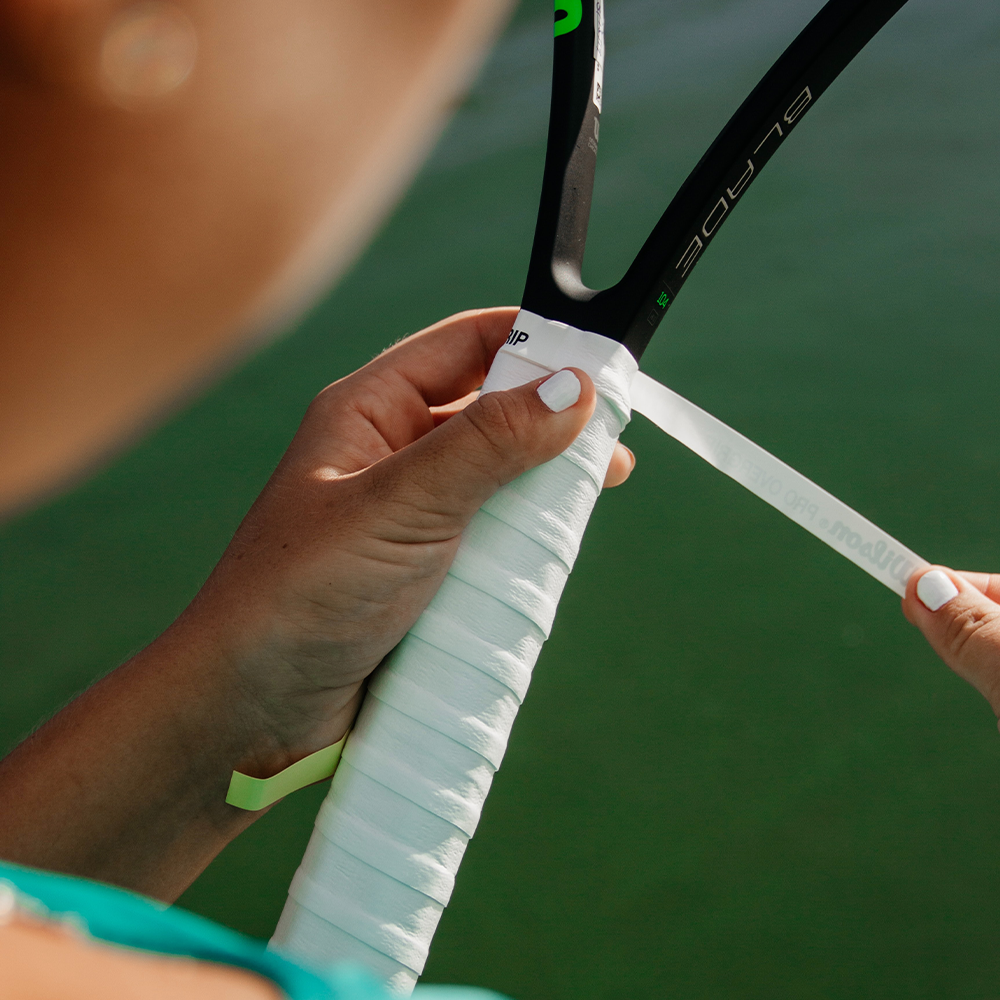
There are five grip sizes availables, 4 1/8, 4 ¼, 4 3/8, 4 ½ and 4 5/8. Also, some adult racquets can be availables in the grip size zero which is considered as a junior grip size.

Important: having a grip size too small for you could cause injuries such as tennis elbow. On the other way, a too big grip size will makes the racket less maneuverable.

Ideally, there should be between 5-10mm between the base of the thumb and the ring finger while holding a racket. To verify this, hold the racket as if you were shaking someone's hand, firmly but not too tightly. Hold the grip naturally and verify if the measurement applies for you.

Head size

Refers to size of strung area of a racquet and usually measured in square inches. A larger head size provides more power, spin and a larger sweetspot, while a smaller headsize gives you more control and feel.

Lenght

A longer frame gives more power and reach but will also decrease the maneuverability of the racquet.
27Inches is the standard length of a tennis racquet. Anything shorter is referred as a junior racquet and anything longer is referred as a longbody.

Stiffness

Stiffness of a raquet varies between 55 to 80. There are five categories"

*Please note that the measurements made for the site where done on non-strung racquets. The stiffness between a strung racquet and one that hasn’t been strung varies.

55-59 Soft
60-64 Semi-stiff
65-69 Stiff
70-74 Very stiff
75-79 Ultra stiff

Whenever you hit a ball the racquet will bend or flex. How much the racquet bends depends on how stiff it is. The most important thing you need to know about stiffness is that the stiffer the racquet, the more energy is returned to the ball. The ball is only on your racquet's strings for a very short time so any flex in the racquet is wasted energy and that translates into less power. Stiffer racquets generate more power and they also have a larger sweet spot.

A stiff racquet should have a good anti-vibration system at the frame level so that is absorbs the shocks. A soft racquet could cause damages to the arm and shoulder of someone who does not play with great acceleration speed at the moment of hitting the ball.

String

Tension of the strings goes from 18 kg or 40 pounds to 35 kg or 77 pounds.

NATURAL GUT :
Natural gut strings are made of cows gut.
ADVANTAGE:
Superb elasticity, incredible playability, great power, good spin, comfort, tension stability and sensation.
DISAVANTAGE:
The natural gut is more expensive and is easy to break.

NYLON :
The most popular used string type. Nylon strings are among the most reasonable tennis strings and are normally made of a single nylon core and various resistant wraps. They are basic strings.
ADVANTAGE:
The average strings. Not expensive..
DISAVANTAGE:
Less comfortable than the natural gut and multifilament. It can quickly loose its tension and playability.

POLYESTER :
Polyester strings is consisted of a single polyester fiber with a thin coating. This type of construction is termed "monofilament". Polyester strings are little elastic and feel quite stiff compared to nylon or multifilament strings, but on the other hand they provide significantly better durability and control.
ADVANTAGE:
Great durability, control, great spin.
DISAVENTAGE:
Less comfort and sensation than the natural gut or multifilament.

MULTIFILAMENTS:
To bring synthetic strings playability more similar to the natural gut, many microfibers (which can be of many different materials) are twisted together to a string, which is wrapped with a resisant cover.
ADVANTAGE:
Higher elasticity and great playability. Less expensive than the natural gut.
DISAVANTAGE: multifilament strings tend to break soon once the outer wrap is damaged.

Type of racquet

1. Power.
Those racquets usually come with oversize or super oversize heads (105-135 square inches), are extremely light in weight (8-10 ounces), wider in their profile (26mm-30mm+ viewing the racquet''s width from the side), longer than the standard 27 inches, and are usually balanced more on the head heavy side, placing more of the weight in the area of ball impact. These racquets are also pretty stiff and when you combine all of these characteristics, they serve to compliment a player with a slower more compact swing.

2. Control Racquets
This racquet is also sometimes referred to as a player''s racquet because it''s designed for the more advanced hitter. They have a narrow profile (17mm-22mm), smaller head size (85 sq in to 100 sq in), are much heavier (11 oz & up), and are more evenly balanced in weight, allowing for more manoeuvrability at the net due to the lighter head weight. Players who use these racquets aren''t looking for the racquet to produce power. Their playing ability allows them to generate all the power they will ever need in any given situation. This player is looking to maximize control in their game.

3. In-Between Racquet
Sometimes referred to as allround racquet, these models offer a nice mix of characteristics between the other two categories mentioned. They can be as light as 9 ounces and as heavy as 10.5 ounces, balanced anywhere along the spectrum, can have any head size the player prefers, and can be a standard 27 inches long or longer. In short, these racquets are not specific to one particular player as is the case with the game improvement or control models. Players using this racquet are not beginners and are usually not extremely advanced in their play either. They fall somewhere in between. Intermediate to advanced players will find this category fits their profile more often than not.

4. Adult Pre-strung
These are generally considered price point racquets that are great for any beginner looking for an introduction to the game of tennis. Pre-strung models are very inexpensive, with price ranges as low as $49.99 up to $119.99.les

Weight

How to choose the good weight for you depends more of your game level and your physical abilities.

Assuming that all tennis racquets tested are the same:
The lighter racket will be more maneuverable and easy to swing with, but the heavier racket will have more power. A heavier frame will be more resistant from twisting on ball impact and will have less vibrations also.

Ideally, lighter and head heavy racquets are better for the slower game as they deliver more power.
Heavier even balanced or headlight racquets are better for advanced players to have a faster game without injuries and to have more control.

A beginner should use a lighter frame because a too heavy racket could be hard to play with and could give shoulder problem with the time.

Weight distribution

Weight distribution varies between 250 to 350. There are seven classifications for weight distribution.

260 - Hyper light head
261-280 Very light head
281-295 Light head
296-310 Even
311-324 Heavy head
325-349 Very heavy head
350 + Hyper heavy head

Measure of how heavy a racquet feels when swung (maneuverability). The swingweight is dependent on several factors, including racquet weight, length, balance, head size. A heavy swingweight racquet is more powerful and will have more stability than a light swingweight racquet but will be less maneuverable. Also, a heavy swingweight racquet can be relatively light in overall weight by placing the majority of weight in the head.

However, a too heavy racquet in the head can give shoulder problem if you do not have the ability to play with a head heavy frame.

Badminton

Choosing a badminton racquet

Proper choice of racquet is therefore extremely personal, and must take into consideration:
o style of play – attacking, defensive, etc.
o preference for singles or doubles
o level of play: Beginner, intermediate, advanced
o importance of durability versus playability.

Features to look at

68 cm frames will add power compared to 67 cm racquets with the same speed of stroke and wrist action. Lengthening and shortening one’s grip between power shots and touch or reaction shots is common among advanced players.

Generally, long swing motion is better suited to heavier racquets. Short, quick swings are better suited to light racquets. Some players will choose a light racquet for doubles, looking for the extra speed for all the quick reactions required; and a heavier racquet for singles where more time is available for stroke preparation, and the extra weight can help with baseline to baseline shots.

One piece graphite frames and up

Power in badminton comes from momentum at the point of contact with the shuttle, and the transfer of energy via the strings . This momentum results from a combination of head weight and sweet spot speed. The latter is related to distance from the hand to the sweet spot (ie. length of the racquet and geometry of racquet head).

Between weight and speed, the racquet speed at the point of contact is generally the key factor in power, assuming that contact is made at the optimum spot on the string bed.
- There is an upper range at which weight begins to hamper power because of the difficulty of generating head speed. This will vary according to a player’s strength and technique. For good results, avoid frame weights over 95g.

- Similarly, there is a lower range where lightness doesn’t bring enough extra speed. This is an issue of racquet length and a player’s technique and biomechanical limitations (a longer racquet will perform better at a lower weight).

Squash

Balance of the racquet

Racquets vary substantially as to where their center of balance lies. Here is a factor that can best be established by trying out the candidate racquet on court. It is usually fairly easy to feel when the racquet has "bad balance" -- that is if it is head heavy or head light. Try out the racquets and reject ones that don't feel right: A racquet that feels really heavy is usually head heavy. The balance varies from one racquet to another within a model line -- so you need to insist on trying out the specific racquet you propose to buy.

Shape of the racquet head

Racquet manufacturers experiment with different racquet heads and market the results of their experimentation. In general, larger racquet heads give you a greater margin for error and also additional power.

Be aware of the design and shape of the throat of your proposed racquet. Certain racquet throat designs make for decreased racquet durability. Look to your squash professional's advice in this area. As a general statement, racquet manufacturers will create a series of racquet models with slightly different throat designs at different price points. Usually, the stronger racquets are also more expensive. An example is the Head Pyramid Power line. With the "Pyramid Power 150" affording excellent durability and play.

Stiffness of the racquet

Racquets vary totally with regard to their "whippiness." Try out for yourself racquets that are very stiff and then racquets with different degrees of give and test out how your shots perform with these different racquets. The best racquet for you will be dependent on your style of play and your level of expertise. If you can control it, a stiffer racquet is usually superior for both shot making and the power game.

Racquet stiffness, though, in the final anaysis is totally a question of personal style. Be aware of the stiffness of racquets you play well with, and try to be consistent in the racquets you use.

Weight of the racquet

The weight of the racquet is its most obvious characteristic, and the weights are quite variable. The lightest racquets weigh in at about 120 grams, and heavy ones can be 210 grams or more. Most typically, racquets in the 140 to 170 gram range are used. As an oversimplification, less expensive racquets are the heaviest, and lighter racquets will cost you more. Stronger materials must be used to allow a racquet to be fabricated at a lighter weight.

Racquetball

Grip size

Advanced player racquets are available in two different grip sizes,
super small (3 11/16") and
extra small (3 15/16").
The smaller the grip, the more wrist snap you can generate, and the more power you can produce. To choose a grip size, grasp the base of the handle and shake hands with it. You should be able to wrap your fingers around the handle that your middle finger almost touches the palm of your hand so that your middle finger almost touches the palm of your hand.

Identify your playing style

Shorter Strokes/Faster Swing Speed – Lighter racquets are ideal for these player types who are seeking more maneuverability, control, and fast-action power.

Longer Strokes/Slower Swing Speed – Heavier racquets with a stiffer frame and larger sweet spot are beneficial for more power and precise shot making. However, lighter weight racquets will benefit these players during fast-paced rallies.

Ping-Pong

Handles

Handles
Picking the right handle is extremely important. The general rule of thumb is: Flared (FL) handles are best for looping while straight (ST) handles are fantastic for smashing. Anatomic (AN) or concave (CO) are perfect for those that do a combination of both.

How to choose a blade

We have classified blades into 3 main categories—Control, Offensive, and Power—depending on your style of play. Analyze your style and determine the predominant strategy you use in competition.

Control Blade:
For the player who doesn’t like taking chances. If you are not a risk-taking player, and you value getting the ball on the table more than taking the chance of blasting one at top speed, then a Control blade is for you.
This blade is also for the defensive player of either style: Classical, in which you avoid making your own mistakes; or Modern, in which you try to provoke your opponent into making mistakes.

Offensive Blade:
For the aggressive player who emphasizes topspin and consistency. The Offensive style of play can vary greatly between players. Some offensive players concentrate on provoking errors from their opponents by attacking and blocking. Others simply like to outlast their opponent while playing aggressive points. All of these players have very good ball control and placement as well as a clear understanding of spin. This style of player will generally deliver heavy spin on both the serve and serve return.

Power Blade:
The carbon, graphite, and titanium blades in this category provide extra control with slightly larger sweet spots than their all-wood counterparts.

Plies
Blades are composed of one or more plies. The number of plies does not always determine the speed. The composition, the placement of the plies, and the way they are glued together determine the blade’s characteristics.


Rubbers

To make your choice easy, we have used the same classification system with rubber as we do with blades.
Due to the new speed glues, it is possible for a rubber sheet to fall into more than one category. When freshly
re-glued, many of the softer sponge rubbers increase both spin and speed without giving up much control.

CONTROL RUBBER
If you still have some difficulty reading spin, this is your rubber type. Nothing can be more frustrating than missing because your rubber is too lively. The Control player enjoys rallying and outlasting their opponents with placement rather than with speed or spin.
Defensive players will often use Control rubber to help absorb the fierce drives and smashes that come at them.

OFFENSIVE RUBBER
For the aggressive player who emphasizes topspin and consistency. The products in this category also allow you to change the pace of the rally and to easily vary the trajectory on loops. This style of play emphasizes delivering heavy spin on both serve and serve return. If you like to set up the point to smash, but sometimes misread spin, then choose from this category to give yourself the best chance to win.

POWER RUBBER

For the offensive player who dominates the play. Starting right from the serve, a Power player tries to end the point as quickly as possible. The player will employ devastating loop drives, smashes, and counter attacks. This type of style requires a great understanding of spin and placement, as the equipment combination they use is the liveliest

When Should Rubber be Changed?

Elasticity and tackiness of rubbers diminish with use and with age. During play, dust particles penetrate the rubber causing it to lose its tackiness. Exposure to heat, light, and air causes the rubber to deteriorate. As the rubber’s characteristics change, the player must adjust his technique. This means that more effort is needed to execute the same shot.
That’s why we recommend you take the utmost care of your equipment The speed and the spin that a player creates with each shot also causes the rubber to wear out. A quick test is to compare the tackiness of the center of the rubber (the section used to hit the ball) with that of the outer edges.
You should change your rubber when it is no longer capable of producing the spin and speed you require. The average world-class player changes his rubber after about 35 hours of play (approximately every week). A player who practices regularly and takes part in tournaments can use his rubber for about 75 hours (2 to 3 months). A recreational player can use his rubber for about 150 hours (6 to 12 months). An occasional player can use the same racket all his life! (Pips out and anti-spin rubber last longer.)

Product Search

Communicate with
us directly
Current time in store :

Bookmarks 

Subscribe to our newsletter

TennisZon - TennisZone is specialized in the sale of racket sports equipment : Tennis, badminton, squash, racquetball and ping-pong. Get in the zone and discover quality products and tips on racket sports. Discover new products and promotions throughout the different zones of the web site.